Welcome to our Carnivore / Ketovore / Keto Online Community!
Welcome to Carnivore Talk! An online community of people who have discovered the benefits of an carnviore-centric ketogenic diet with the goal of losing weight, optimizing their health, and supporting and encouraging one another. We warmly welcome you! [Read More]
Just some musings I had today.
- Replies 4
- Views 2k
- Created
- Last Reply


Popular Days
Most Popular Posts
-
I quit smoking in 2008 before I met my husband. He made me promise to never do it again. And that promise is what has held me at bay on those warm spring days when cigarette smoke smells good to me.
-
I gave up cigars about twelve years ago. My cat thought I was purring at night and I had to stop to catch my breath just walking up the boat ramp. Still to this day I get the urge every time I watch a
-
I also cling to the premise of JOMO...the joy of missing out. I will enjoy not getting the blues from eating those cookies or that cake. I will enjoy missing out on IBS if I avoid that potato salad.
Featured Replies
Featured Content
-
"World Carnivore Month" January Challenge!
Today is the first day of January and is also the first day of World Carnivore Month. To that end, let's challenge ourselves to eat a carnivore diet for the entire month of January. The type of carnivore diet and the level of strictness you choose to do is entirely up to you. Examples of carnivore diets include the following... 1) The Lion Diet. A person eating the Lion Diet only consumes the flesh of ruminant animals, water, and salt. 2) The BBBE Diet. BBBE is an acronym for Beef, Butter, Bacon, and Eggs. 3) The Carnivore Diet. This allows for the consumption of any and all animals and animal by-products, including dairy. In any of the above examples, the object of course is to not consume any plants as part of your diet. Of course, we're not going to micromanage hoe you prepare your food, so your use of seasonings is entirely your own personal choice. IF your circumstances don't allow you to go full on carnivore in January, then you can participate in this topic by challenge yourself to do better, above and beyond what you have been doing. For example, if you have still been eating grains, seed oils, refined sugar, or drinking alcohol, challenge yourself to avoid these items and just eat a clean, single ingredient whole foods diet such as clean keto, ketovore, or animal based. We encourage you to check in daily, and share what you have eaten, perhaps a weigh-in if you're willing, and enjoy in some small talk. Participants in this topic will be entered into a drawing for a prize at the end of the month.-
- 193 replies
 Featured by Guest
 -
-
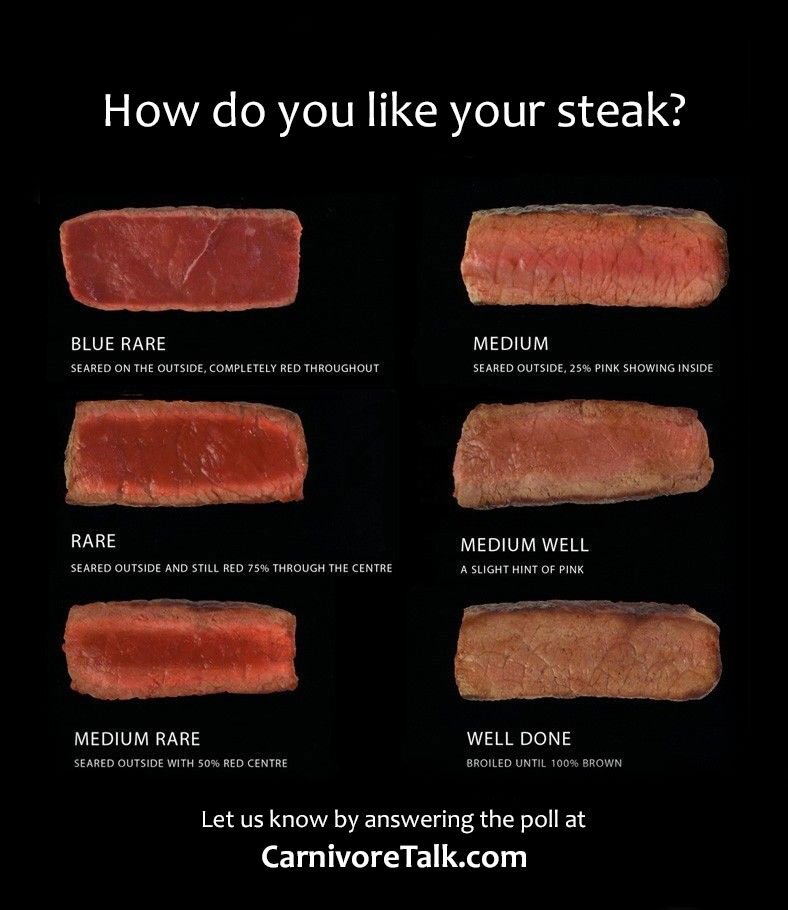
What is your favorite way to eat/prepare eggs?
Vote for your favorite way to prepare eggs!
- 45 replies
Featured by Bob



A personal perspective on cravings, desires & memories.
Craving,
an intense, urgent, or abnormal desire or longing.
Desire,
impulse toward something that promises enjoyment or satisfaction in its attainment.
Something longed or hoped for : something desired.
To feel the loss of
When I became a carnivore my mindset was that I would not fail. Nothing could trip me up. The foundation of that attitude was instilled in me by my career military father who served in three wars and was the the strongest, fairest and toughest man I’ve ever known. Upon that foundation the US Army Infantry fortified that no quit attitude into something rock solid.
Not only will I not fail, I cannot fail.
Your mindset is what carries you through thick and thin.
68 years ago I stopped using tobacco. I had dipped snuff for 33 years. I dipped one can of Copenhagen snuff a day. That’s the nicotine equivalent to 60 cigarettes a day. To say I was addicted would be an understatement. Ci made myself a promise that I would quit when I turned fifty and that I did. My mindset was that I could not fail.
I’ve never been a drug user but it’s been said that the withdrawals from a snuff addiction is comparable to a cocaine addiction. It didn’t matter how tough it was, I could not fail. I knew that is I ever allowed tobacco in any form to touch my lips I’d never be able to quit again. The cravings were strong but they only lasted about two or three weeks. But to be honest, it took ten years or so for the desire to abate.
The craving is nearly uncontrollable and says I’d kill for just one more taste. It’s viscous and brutal but the desire is subtle and inviting. Very coy and dangerous as the Sirens to Odysseus she entices you with past memories of pleasure.
18 years later I have not failed. I am free of tobacco. Even the Sirens do not tempt me anymore.
I can equate the addiction to carbohydrates as being no different.
The cravings can be unbearable at times but they can be overcome. They can be defeated but the mindset must be that of one who cannot fail.
I find that the cravings are easier to defeat than the desires. The cravings last for a short time but the desires can last for years fueled by the memories of long past pleasures.
Identify what it is you are feeling in yourself. Is it actually a craving, that gnawing feeling clawing at your insides saying if you don’t give in you’re going to destroy something?
Or is it that Siren of Odysseus calling to you to relieve that past pleasure?
That feeling of loss in your life?
The mindset to defeat the craving is that if I cannot lose. I will not be defeated. Nothing can stop me. It takes grit and determination.
The mindset to overcome the desire is one of patience. Not the passive patience that says: “This is boring. Nothing good happens to me. This is too hard. The world owes this to me. There’s nothing to be excited about. I’m helpless.”
But active patience that says: “It’s ok to slow down. What are my values and goals? What’s the next step right in front of me that I can take to get me closer to my values and goals? There is no reason to give up. Timing is out of my control, but when I let go of helplessness, the process itself is splendid.”
It is then easy to push that desire aside and fondly remember that memory of bygone pleasures without fear of giving in to the Siren.
KCCO
Sent from my iPhone using Tapatalk