
Bob
Community Manager
-
Joined
-
Last visited
-
until
**Is the Carnivore Diet Dying—or Just Getting Started?** Critics are declaring the carnivore diet's downfall. New scientific reviews are questioning its long-term safety, headlines continue to warn against eating meat, and some claim the carnivore movement is losing momentum. But is carnivore really on its way out? Just as critics are writing its obituary, a powerful new documentary, *Healing Humanity: The Power of a Proper Human Diet*, is telling a very different story. Produced by Kerry Mann (HomesteadHow) and his team, *Healing Humanity* explores the remarkable experiences of people who credit animal-based nutrition with transforming their health and their lives. So who's telling the real story? WATCH: https://www.youtube.com/watch?v=JWREucU0FnU Tonight on **Carnivore Talk**, Bob and Geoff discuss the newly released documentary, the latest criticism surrounding carnivore, and the growing divide between mainstream nutritional advice and the experiences of people embracing a meat-based lifestyle. We'll explore: - The release of *Healing Humanity* and its powerful message. - Why some critics claim the carnivore movement is losing steam. - What recent scientific reviews actually tell us—and what they don't. - The difference between declining popularity and genuine dietary effectiveness. - Whether carnivore is simply another passing diet trend or part of a lasting shift in how we think about nutrition. And, as always, we want to hear from YOU! Have you watched *Healing Humanity*? What did you think? Has carnivore changed your life? Do you believe this movement has peaked, or are we only beginning to see its potential? **Join Bob and Geoff LIVE tonight for an open, honest, and thought-provoking conversation!** 🎬 *Healing Humanity*: https://healinghumanity.movie/ 🔔 Subscribe to Carnivore Talk and join our weekly Monday night livestreams! HERE'S HOW TO JOIN US ONSCREEN AS A GUEST... https://carnivoretalk.com/events/ LET'S DO A VIDEO TOGETHER! Have YOU had success with a meat-based keto, ketovore, carnivore, carnivore-centric, or animal-based diet? Let's do a video together! Contact me using this form... https://carnivoretalk.com/contact/ JOIN THIS CHANNEL TO GET ACCESS TO PERKS! https://www.youtube.com/channel/UCeAwaxsqfNEK4ZtfWX3Dz3g/join VISIT OUR FREE KETO/CARNIVORE COMMUNITY! https://www.CarnivoreTalk.com HAVE YOUR QUESTION ANSWERED IN A FUTURE VIDEO: Click the link below to leave us a Voicemail, and we might feature your question on the next episode of Carnivore Talk. https://carnivoretalk.com/voicemail/ DISCLAIMER: The Carnivore Talk website, and its audio and video content are for general informational purposes only. The use of the information found within our content or from materials linked to from our content is at the user’s own risk. The content published by Carnivore Talk is not intended to be a substitute for professional medical advice, diagnosis, or treatment. Users should seek the assistance of their health care professionals to obtain medical advice and to diagnose or treat any condition. We are NOT doctors! #CarnivoreDiet #HealingHumanity #CarnivoreTalk #ProperHumanDiet #AnimalBased #MeatBasedDiet #LowCarb #CarnivoreLifestyle -
 Geezy reacted to a post in a topic:
Just one small serving of ultra-processed food a day linked to higher disease risk, major study finds
Geezy reacted to a post in a topic:
Just one small serving of ultra-processed food a day linked to higher disease risk, major study finds
-
-
**Shawn Baker Ate Fruit for 30 Days. Did Anything Change?** After nearly a decade eating carnivore, Dr. Shawn Baker experimented with adding whole-food carbohydrates—primarily fruit, along with plain Greek yogurt and a little honey—for 30 days while continuing to eat meat daily. What happened to his weight, appetite, food cravings, and performance? And what can his experience tell us about strict carnivore versus a more flexible, meat-centered way of eating? In this episode of Carnivore Talk, we're breaking down Baker's experiment and discussing a bigger question: **Does building a sustainable, meat-first lifestyle mean eliminating plants forever?** Our philosophy is simple: make single-ingredient whole foods the foundation, keep meat and animal products at the center, and recognize that plants can be optional rather than mandatory. The goal isn't to follow a rigid set of dietary rules forever—it's to find a way of eating that works for you and that you can sustain long-term. We'll discuss what Baker reported, what we can reasonably take away from his experience, and whether adding selected whole foods can fit into a meat-centered lifestyle without losing sight of what matters most. 🥩 **Join the conversation!** Have you ever added fruit or other whole-food plants back into your diet after going carnivore? Did your appetite, cravings, weight, or symptoms change? Share your experience in the live chat or comments! If you enjoy thoughtful conversations about carnivore, keto, and sustainable ancestral eating, **subscribe to Carnivore Talk** and join us for the next discussion. https://www.youtube.com/watch?v=f7sDZa4HOAQ
-
-
-
Just one small serving of ultra-processed food a day linked to higher disease risk, major study findsStory by Deirdre Bardolf Just an extra 3.5 ounces of ultra-processed foods (UPFs) a day was linked to a higher risk of chronic disease, according to a new large-scale analysis. The study, published Sept. 22 in the journal Family Medicine and Community Health, looked at nearly 8.8 million adults who participated in studies across the Americas, Europe, Asia and Oceania, with follow-up periods ranging from two to 32 years. For every additional 100 grams of UPFs consumed daily, researchers found an association with a 14% higher risk of cardiovascular events, a 4% higher risk of cancer, a 3% higher risk of death from any cause and a 2% higher risk of metabolic syndrome or diabetes, according to a news release. UPFs are typically packaged and convenient, made through extensive industrial processing and often packed with additives. They can include sugary drinks, processed meats, packaged snacks and candy. One hundred grams is about the size of a 3.5-ounce bag of corn chips, a small box of candy or a single-serve cup of mini cookies. Ultra-processed foods can include sugary drinks, processed meats, packaged snacks and candy, according to the analysis. iStock© iStock People with the highest intake of UPFs also had higher risks of digestive diseases, depression or anxiety, obesity, cancer and cardiovascular events than those with the lowest intake of the foods. READ ON THE FOX NEWS APP "Given that UPF-related chronic diseases often cluster as multimorbidity, reducing consumption of UPFs and replacing them with minimally processed alternatives may be relevant for chronic disease prevention and primary care management," the researchers, led by Xiao Liu, a cardiologist at Sun Yat-sen Memorial Hospital in China and a research fellow at Duke-NUS Medical School in Singapore, wrote. These types of foods tend to crowd out healthier, nutrient-dense options, according to Kelly Springer, a New York-based registered dietitian and founder of Kelly's Choice. "It's not that you can never eat them again," Springer, who was not involved in the research, told Fox News Digital. "It's the fact that we are not getting real foods — real foods like fruits, vegetables, beans, nuts, whole grains." Researchers said ultra-processed foods can add up throughout the day through snacks, sugary drinks and convenience foods. iStock© iStock Rather than focusing on taking foods away, Springer recommended adding protein and fiber to meals and snacks. She suggested options such as an apple with peanut butter, nuts with cucumbers, or meals built around beans, chicken or tuna alongside fruits, vegetables and whole grains. "A diet built around whole, minimally processed foods is one of the best investments we can make in our long-term health," she added. Springer noted that the study was observational, so it cannot establish that UPFs directly caused the poor health outcomes. It also relied on participants' self-reported diets and may not be able to account for other lifestyle factors. Nonetheless, the study can teach people about the link between ultra-processed foods and chronic disease, Springer said. ARTICLE SOURCE: https://www.msn.com/en-us/health/general/just-one-small-serving-of-ultra-processed-food-a-day-linked-to-higher-disease-risk-major-study-finds/ar-AA2cQVsy?
-
I can't think of anything I am doing that is out of the ordinary and considered a good habit, and least not beyond the basics. I've kicked my last vice, which was soda. I might still have one every once in a while, but I have finally acquired the taste for just plain water (as well as fizzy water). I spend most of my life drinking diet sodas. I don't have hair so I only use bar soap, which I get from Sam's Club in bulk. They did start carrying Dr. Squatch and I did try it and it was okay. It's supposed to be better for you - all natural and all that. I am more regular at brushing my teeth - at least once daily now. I really don't care what toothpaste it is either. I've switched from plastic flippers, ladels, and tongs to wooden ones, and prefer real silverware over plasticware when it comes to cutlery. I think the phone/screen time goals are rather admirable. But I run a business (construction in real life, YouTube online) so that would never work for me. I sleep on waterbed from the 70's. I'm in love with it. It fixed my back pain when I got it 20 years ago. I will die before giving it up, lol :)
-
-
-
-
-
-
-
-
-
-
-
-
-
-
-
You can do it. All of the above is Bob-approved (lol) except for those crackers. Eat them till they're gone and then don't buy anymore, lol. For that crunch, if your keto or still migrating towards carnivore -> Quest Protein Chips are alright, but way too expensive. For a pure carnivore, pork rinds is what most of us turn to for that crunch. And I will eat just about any flavor of pork rinds too because I'm not a purist.
-
-
-
-
Hey Mary. Sorry for the late reply. I've been busy with my in-real-life tile and remodeling business and this post got buried before I could see it. If I organized a meetup up here in the Northeastern Ohio area, would you be interested? It looks like you've done your homework. I am not alarmed by the numbers you shared. The red blood cells living longer is one of the reasons why the A1C might creep up. It's using a calculation that assumes a 90 day lifespan for a red blood cell. If you don't eat sugar, you can't be a type 2 diabetic, plain and simple. With the absolutely beautiful HDL and Trigs, the LDL doesn't concern me either. Trust me, mine is much higher. Nick Norwitz is even way higher. Have you watch "The Cholesterol Code" which he and Dave Feldman produced? It's free on YouTube now. The protective barrier of the arterial lining is called the glycocalyx. It's a protective slimy lining. It's vulnerable to damage from sugars, and when the glycocalyx is damaged then it's easier for inflammation to occur in the arteries and LDL to get lodged in the arterial wall. If you have a healthy slimy glycocalyx, the LDL is just going to bounce right off it and keep circulating.
-
True that. I agree that it doesn't, and also that it's impossible to test. Problem #1 is food frequency questionaries are not reliable by any means. Problem #2 is these meat eating survey participants probably bring along a host of confounders, like eating processed grains, sugars, smoking, being a couch potato, etc. And then it's worth noting that there IS a difference between processed meat and fresh meat. But how much difference and how important is the difference? According to Dr. Ken Berry, meat is meat, and the sodium nitrate in processed meat is nothing to fear so go ahead and enjoy your bacon. He even says you could do a carnivore diet effectively on just hot dogs and bologna if that is all you could afford.
-
Remind me how tall you are? I'm just curious. I am 5'8" and sitting at an even 160 lbs currently. I know what you mean by having control of the dial. I am still strict carnivore most of the time, but every once in a while the wife wants to go out to eat. I can usually stay keto when dining out. But even less frequently someone will invite us over for some hospitality and prepare a meal to share with us. I might stray a little more here - maybe less keto, but still all natural whole foods or a combination of them. Still paleo but maybe more carby. The next day I will be up on the scale, but it's usually back down to my baseline in a day or two. What's really great is it doesn't trigger cravings, or at least not cravings that overpower me. It's like I've outgrown that, lol.
-
Craving tacos on a carnivore or ketovore diet? In this video I show you how to make soft tacos using Egg Life Wraps — a simple egg-based option that works great as a soft shell. No flour, no seed oils, just an easy animal-based wrap that holds up to a solid meat filling. Perfect for anyone eating carnivore, animal-based, or strict keto who still wants taco night. What you’ll see: • How I use Egg Life Wraps as soft taco shells • Seasoning and filling ideas that stay fully animal-based • Quick tips for putting it all together If you try these, drop a comment and let me know how they turned out. https://www.youtube.com/watch?v=FNQI3DATh0w View full episode
-
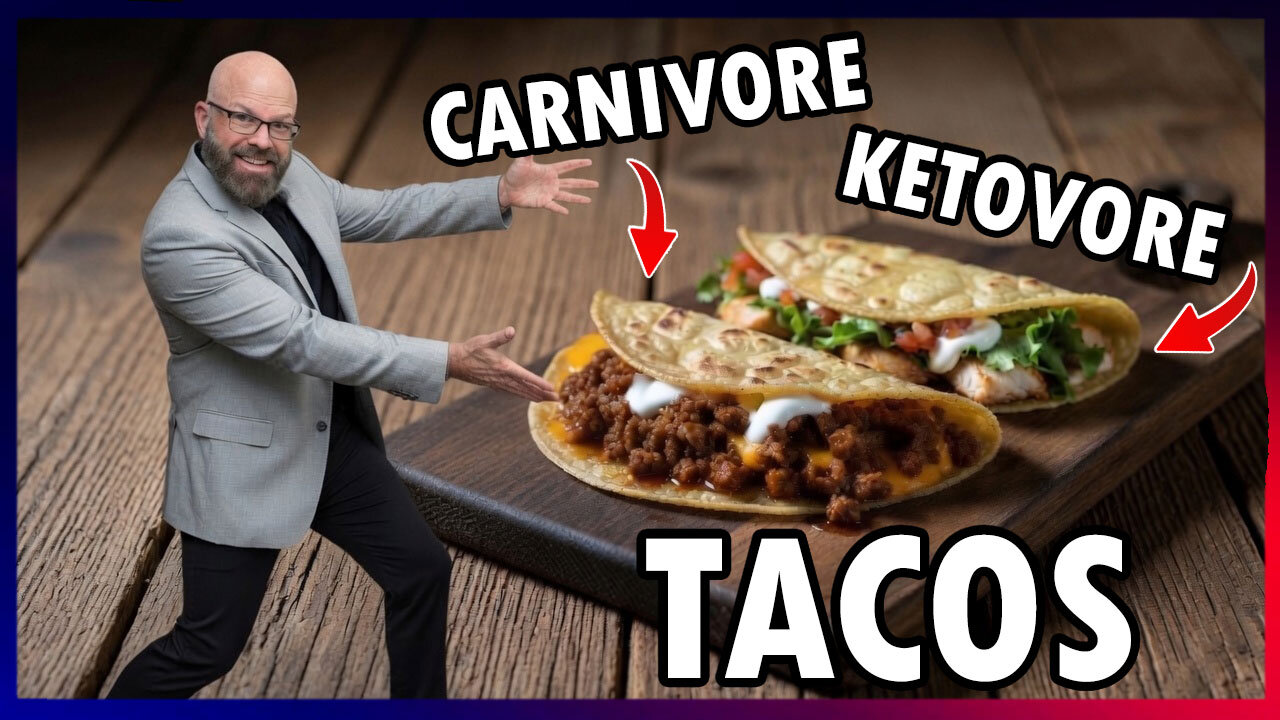 Craving tacos on a carnivore or ketovore diet? In this video I show you how to make soft tacos using Egg Life Wraps — a simple egg-based option that works great as a soft shell. No flour, no seed oils, just an easy animal-based wrap that holds up to a solid meat filling. Perfect for anyone eating carnivore, animal-based, or strict keto who still wants taco night. What you’ll see: • How I use Egg Life Wraps as soft taco shells • Seasoning and filling ideas that stay fully animal-based • Quick tips for putting it all together If you try these, drop a comment and let me know how they turned out. https://www.youtube.com/watch?v=FNQI3DATh0w
 -
until
🥩 CARNIVORE TALK TONIGHT! 😴 You cleaned up your diet. You're eating steak, ditching the carbs… so WHY ARE YOU AWAKE AT 3 AM?! Is it electrolytes? Too little food? Low carbs? Or something else entirely? Bob & Geoff are digging into the research, the myths, and what might actually help. 🔥 Carnivore Is Ruining Your Sleep? Here's What Might Be Happening. Join us LIVE tonight! Bring your experience and your questions. #Carnivore #Keto #CarnivoreTalk WATCH: https://www.youtube.com/watch?v=9bTYwK1SOOo -
-
I would agree with this in general. I knew that empty carbs were bad and the root of my weight issues. I was less aware that they were at the root of some of my health issues too. After all, "I'm just getting older. This is the way it is." is what I thought, just like everyone else. To lose weight AND reverse health issues was amazing. But yes, even though I was aware of it, I didn't act on it until it became an urgency. My health got to the point where I knew I need an intervention, a change, and had to hope it wasn't too late.
-