Welcome to our Carnivore / Ketovore / Keto Online Community!
Welcome to Carnivore Talk! An online community of people who have discovered the benefits of an carnviore-centric ketogenic diet with the goal of losing weight, optimizing their health, and supporting and encouraging one another. We warmly welcome you! [Read More]
My Life with the Eskimo - Vilhjalmur Stefansson [Files Library]
- Views 1k
- Created
- Last Reply
Featured Replies
Similar Content




Featured Content
-
"World Carnivore Month" January Challenge!
Today is the first day of January and is also the first day of World Carnivore Month. To that end, let's challenge ourselves to eat a carnivore diet for the entire month of January. The type of carnivore diet and the level of strictness you choose to do is entirely up to you. Examples of carnivore diets include the following... 1) The Lion Diet. A person eating the Lion Diet only consumes the flesh of ruminant animals, water, and salt. 2) The BBBE Diet. BBBE is an acronym for Beef, Butter, Bacon, and Eggs. 3) The Carnivore Diet. This allows for the consumption of any and all animals and animal by-products, including dairy. In any of the above examples, the object of course is to not consume any plants as part of your diet. Of course, we're not going to micromanage hoe you prepare your food, so your use of seasonings is entirely your own personal choice. IF your circumstances don't allow you to go full on carnivore in January, then you can participate in this topic by challenge yourself to do better, above and beyond what you have been doing. For example, if you have still been eating grains, seed oils, refined sugar, or drinking alcohol, challenge yourself to avoid these items and just eat a clean, single ingredient whole foods diet such as clean keto, ketovore, or animal based. We encourage you to check in daily, and share what you have eaten, perhaps a weigh-in if you're willing, and enjoy in some small talk. Participants in this topic will be entered into a drawing for a prize at the end of the month.-
- 193 replies
 Featured by Guest
 -
-
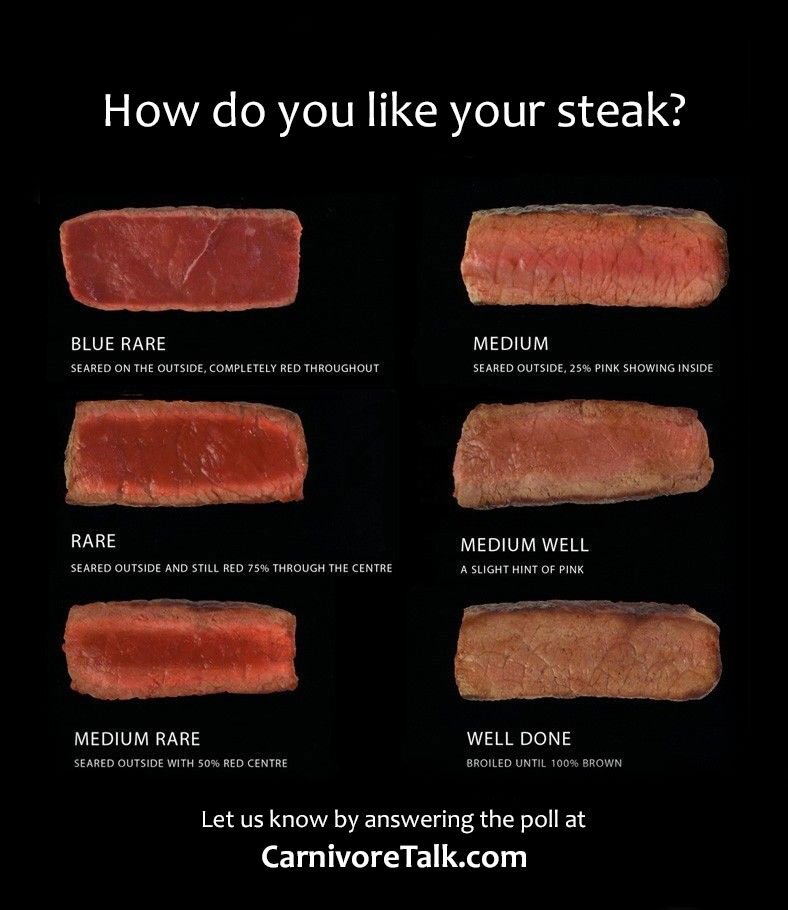
What is your favorite way to eat/prepare eggs?
Vote for your favorite way to prepare eggs!
- 45 replies
Featured by Bob



View File
My Life with the Eskimo - Vilhjalmur Stefansson
Who are the Eskimo peoples?
And how do they survive in the freezing conditions of the far north?
Vilhjálmur Stefánsson left New York in April 1908 to begin his journey northwards and into the Arctic Circle. For the next two years he made his way northwards to Victoria Island to study an isolated group of Inuit who still used primitive tools and had strong Caucasian features, and whom some believed were descended from Vikings. The journey into these remote areas was incredibly tough and being delayed by blizzards, Stefánsson, along with his companions, were forced to eat the tongue of a beached whale that had been dead for at least four years. Stefánsson, who learnt how to communicate with the Inuit, provides fascinating insight into the beliefs and everyday life of these people.
“The book is full of psychologic and human interest, and of clear-cut observation of many different kinds.” The North American Review
“This book contains a wealth of ethnological and biological information … this is a valuable contribution to the scientific study of the Eskimos, by one who knows them thoroughly.” The Literary Digest
“It is impossible to analyze with certainty the amalgam of motives underlying the ceaseless movement of northern exploration, but the lure of the difficult and the dangerous can hardly be less active than the desire to enlarge bounds of human knowledge.” The Nation
This book is essential reading for anyone interested in this remarkable expedition and for people who want to find out more about life of people in the far north prior to the advent of modern technology.
Vilhjálmur Stefánsson was a Canadian Artic explorer and ethnologist. Under the auspices of the American Museum of Natural History, New York, he and Dr. R. M. Anderson undertook the ethnological survey of the Central Arctic coasts of the shores of North America from 1908 to 1912. The results of this expedition were My Life with the Eskimo first published in 1913. Stefánsson passed away in 1962.