Welcome to our Carnivore / Ketovore / Keto Online Community!
Welcome to Carnivore Talk! An online community of people who have discovered the benefits of an carnviore-centric ketogenic diet with the goal of losing weight, optimizing their health, and supporting and encouraging one another. We warmly welcome you! [Read More]
Harvard Has Been Anti-Meat for 30+ Years - Why?
- Replies 1
- Views 1.3k
- Created
- Last Reply
Top Posters In This Topic
-
Geezy 1 post

Popular Days
Posted Images

Featured Replies
Similar Content
-
- 5 replies
- 6,152 views

Featured Content
-
"World Carnivore Month" January Challenge!
Today is the first day of January and is also the first day of World Carnivore Month. To that end, let's challenge ourselves to eat a carnivore diet for the entire month of January. The type of carnivore diet and the level of strictness you choose to do is entirely up to you. Examples of carnivore diets include the following... 1) The Lion Diet. A person eating the Lion Diet only consumes the flesh of ruminant animals, water, and salt. 2) The BBBE Diet. BBBE is an acronym for Beef, Butter, Bacon, and Eggs. 3) The Carnivore Diet. This allows for the consumption of any and all animals and animal by-products, including dairy. In any of the above examples, the object of course is to not consume any plants as part of your diet. Of course, we're not going to micromanage hoe you prepare your food, so your use of seasonings is entirely your own personal choice. IF your circumstances don't allow you to go full on carnivore in January, then you can participate in this topic by challenge yourself to do better, above and beyond what you have been doing. For example, if you have still been eating grains, seed oils, refined sugar, or drinking alcohol, challenge yourself to avoid these items and just eat a clean, single ingredient whole foods diet such as clean keto, ketovore, or animal based. We encourage you to check in daily, and share what you have eaten, perhaps a weigh-in if you're willing, and enjoy in some small talk. Participants in this topic will be entered into a drawing for a prize at the end of the month.-
- 193 replies
 Featured by Guest
 -
-
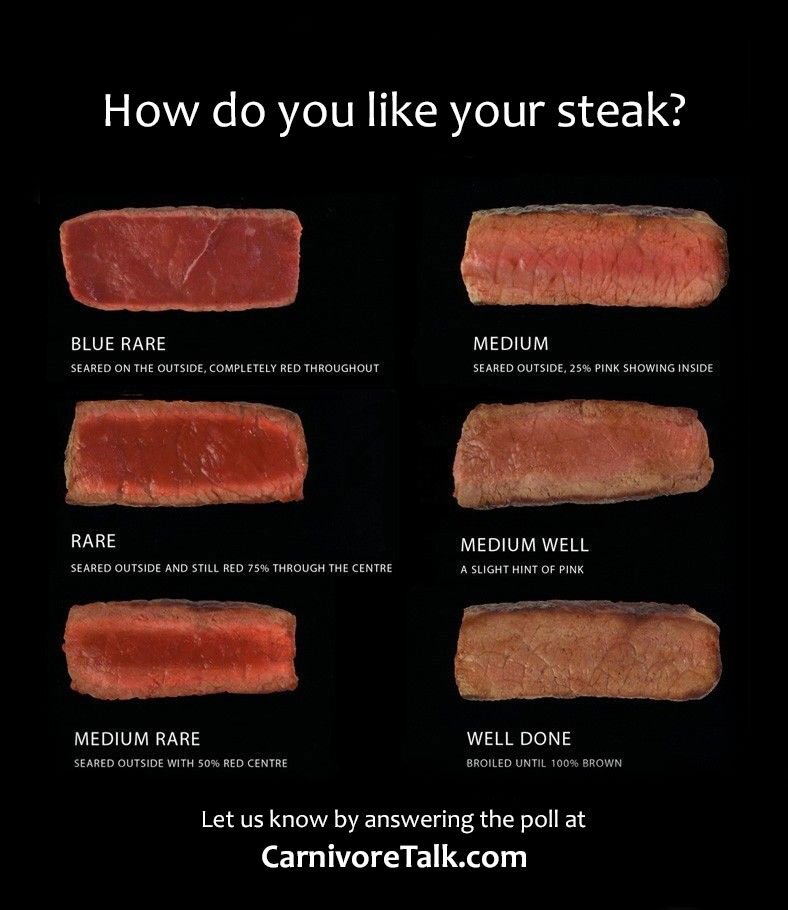
What is your favorite way to eat/prepare eggs?
Vote for your favorite way to prepare eggs!
- 45 replies
Featured by Bob



While this article is not technically from "the news media" it is quite an awesome piece of journalism. It's written by Nina Teicholz, author of The Big Fat Surprise - Why Butter, Meat, & Cheese Belong in a Healthy Diet. She publishes a newsletter on substack that you could and should subscribe to called Unsettled Science.
Article Source: https://unsettledscience.substack.com/p/harvard-has-been-anti-meat-for-30
Below is just the introduction of her article. Click the above link to read the whole thing.
Harvard Has Been Anti-Meat for 30+ Years—Why?
Red meat is bad for health. We hear this from virtually all our nutrition authorities, and so, it must be true. Far less well known is the fact that this fear of eating red meat can mainly be traced back to a single person, Harvard’s Walter C. Willett, the first and most prominent anti-meat champion in academia. Indeed, in 1990, the year before he started his 25-year reign (1991-2017) as head of the highly influential Harvard T.H. Chan School of Public Health (HSPH), Willett said it’s “quite possible” that “no red meat” was the optimal amount to eat.1 His more recent work has involved leading an international effort for a near-meatless diet for all people, globally. Yet this passion has never had a foundation in solid evidence. Rather, it has been based in a mixture of personal ambition, bad science, financial interests and bias.
Willett’s unswerving advocacy for vegetarianism helps provide some context for his latest paper (paywalled), claiming that red and processed meat are “strongly associated” with an increased risk of type 2 diabetes. As the accompanying Harvard press release explained, “participants who ate the most red meat had a 62% higher risk of developing type 2 diabetes compared to those who ate the least.” The findings spurred at least a hundred headlines worldwide, including this one in The NY Times and another in the Washington Post (syndicated from Bloomberg): “Drop that Hot Dog if You Value Your Health.”
Scary news indeed for the more than half of American adults estimated to have pre-diabetes or diabetes in 2012 (today’s number is no doubt higher), and this news will surely give many people pause about choosing steak instead of something from “plant protein sources,” which the Harvard researchers say are not only healthier but also better for the planet. “Swapping red meat for healthy plant protein sources would help reduce greenhouse gas emissions and climate change, and provide other environmental benefits,” they assert. The climate change implications are serious, and we should not dismiss them, yet we’re concerned here about human health—and so will stick to that.
The errors of science in the Harvard paper are both superficial and profound. However, the bigger question is: why do Willett and HSPH put out such a constant stream of findings against animal foods when nutritionists for generations have argued, with good reason, that these foods are vitally important, if not essential to human life? Meat contains all of the essential amino acids, in the ratios that are ideal for humans. They are rich in twelve of the thirteen essential vitamins. Meat, especially, is an excellent source of vitamins A, E and all the B vitamins. Vitamins D and B12 are found only in animal products (although we might be able to get sufficient vitamin D with enough outdoor exposure to the sun). Thus, whatever we might think about eating animal foods, they are, due to their essential nutrient and ideal protein content, almost certainly crucial for the proper development and functioning of all human beings. Arguing against these foods is like taking the nutrition out of nutrition studies.
What’s certain is that for 30 years, Willett has been a fervent champion of a vegetarian diet. His advocacy is run through with ideological beliefs, some linked to an actual vegan-promoting church, and it’s hard to imagine that these factors do not interfere with the pure pursuit of science. Complicating this mix are undeniable financial conflicts of interest, including multiple six-figure donations by the food industry to HSPH during Willett’s leadership. These commercial interests converge and dovetail with Willett’s personal zeal for vegetarianism; where one starts and the other ends is difficult to know.
Indeed, Willett’s career can be seen as a case study in how a person’s beliefs can lead them into a web of financial, corporate and even ideological interests aligned with those beliefs. Over the course of a 30-year career, these fuse together into a single piece, a set of golden handcuffs for the mind. Evidence to the contrary might exist, but the researcher either ignores it or finds a way to dismiss it as insignificant.
This article isn't over. There is a lot more to read. Some of the other subheadings are...
Some Inconvenient Observations
Spreading the Word Before Science
A Life Committed to Vegetarianism
A Careeer Funded by Vegetarian Interests
Click here to read the whole article:
https://unsettledscience.substack.com/p/harvard-has-been-anti-meat-for-30
Click here to download the bogus Harvard study...
https://carnivoretalk.com/files/file/6-red-meat-intake-and-risk-of-type-2-diabetes-harvard/
Subscribe to Carnivore Talk on YouTube | Be our guest on the channel | Leave me a voicemail, yo!