Welcome to our Carnivore / Ketovore / Keto Online Community!
Welcome to Carnivore Talk! An online community of people who have discovered the benefits of an carnviore-centric ketogenic diet with the goal of losing weight, optimizing their health, and supporting and encouraging one another. We warmly welcome you! [Read More]
GLP-1 Ozempic VS Carnivore Diet
- Replies 15
- Views 3.8k
- Created
- Last Reply




Most Popular Posts
-
I
-
-
This would make sense. Taking GLP-1 injections makes you less hungry. You feel full, so you eat less. That includes less protein and essential fats and nutrition, which would lead to muscle breakdown.

Posted Images
Featured Replies
Similar Content
-
- 2 replies
- 124 views
-
- 3 replies
- 140 views

Featured Content
-
"World Carnivore Month" January Challenge!
Today is the first day of January and is also the first day of World Carnivore Month. To that end, let's challenge ourselves to eat a carnivore diet for the entire month of January. The type of carnivore diet and the level of strictness you choose to do is entirely up to you. Examples of carnivore diets include the following... 1) The Lion Diet. A person eating the Lion Diet only consumes the flesh of ruminant animals, water, and salt. 2) The BBBE Diet. BBBE is an acronym for Beef, Butter, Bacon, and Eggs. 3) The Carnivore Diet. This allows for the consumption of any and all animals and animal by-products, including dairy. In any of the above examples, the object of course is to not consume any plants as part of your diet. Of course, we're not going to micromanage hoe you prepare your food, so your use of seasonings is entirely your own personal choice. IF your circumstances don't allow you to go full on carnivore in January, then you can participate in this topic by challenge yourself to do better, above and beyond what you have been doing. For example, if you have still been eating grains, seed oils, refined sugar, or drinking alcohol, challenge yourself to avoid these items and just eat a clean, single ingredient whole foods diet such as clean keto, ketovore, or animal based. We encourage you to check in daily, and share what you have eaten, perhaps a weigh-in if you're willing, and enjoy in some small talk. Participants in this topic will be entered into a drawing for a prize at the end of the month.-
- 193 replies
 Featured by Guest
 -
-
What is your favorite way to eat/prepare eggs?
Vote for your favorite way to prepare eggs!
- 45 replies
Featured by Bob



When Ozempic didn't work, I went on a diet doctors warn against... the results speak for themselves
By LUKE ANDREWS SENIOR HEALTH REPORTER FOR DAILYMAIL.COM
Published: 12:15 EDT, 22 April 2025 | Updated: 14:30 EDT, 22 April 2025
At 635lb and struggling to walk, Pete Brennan knew something needed to change.
Showing people houses for his realtor job left him panting and with shooting pains through his knees and feet that would last hours.
His wife had to assume all cooking and cleaning duties at home, leaving him feeling useless and worthless.
Brennan, 39, nearly missed his own wedding, narrowly avoiding being ordered off the plane to Mexico because he was too large to fit into the single passenger seat.
But the breaking point came when Brennan fell in the shower and was unable to stand up, having to ask his five-year-old son Nolan to help him.
'It just kind of made me realize that being selfish, and letting go of myself like I was, that really wasn't the right thing to do,' Brennan told the Daily Mail.
The New Jersey native has now successfully shed more than half his body weight, or 352lbs, in two years while following a diet almost all doctors advise against.
The 'carnivore diet' involves eating only meat products like steak, chicken, eggs, butter and fish.
Brennan is pictured above around his heaviest at 635lbs with two clients. He works as a realtor helping to sell houses
Peter 'Francis' Brennan, 39, has embarked on a mammoth weight loss to slash his weight from 635 to below 250lbs. He is currently at 283lbs, and is pictured above this month
The high levels of fats and low carbohydrates puts the body into ketosis, a state where it burns bodyfat instead of carbohydrates for energy.
Many doctors, including Brennan's, warn people not to use the diet saying that it can cause high levels of LDL or bad cholesterol.
This can cause plaques to build-up in the arteries, restricting blood flow and raising the risk of complications like high blood pressure, heart disease, stroke and a heart attack — which he was already at risk of.
Some, however, say it's a life changer, including podcaster Joe Rogan and controversial psychologist Jordan Peterson.
Advocates say the carnivore diet allows them to lose weight rapidly and boost their energy levels, sleep and sexual performance.
Brennan said he now consumes three meals a day, with each weighing six ounces and composed entirely of eggs mixed with sliced chicken and turkey sausages.
He aims to get in about 130 to 170 grams of protein daily, well above the US National Dietary Guidelines recommendation of about 0.36 grams of protein per pound of body weight — or 101 grams a day for Brennan, who weighs 283lbs.
For snacks, he consumes peanuts and cottage cheese — which aren't strictly part of the carnivore diet but are used in the keto diet to keep burning fat for energy.
He doesn't consume red meat amid concerns that it could cause colon cancer and type 2 diabetes.
Brennan shown in the gym this month
Brennan started on the carnivore diet in June 2024, after spending a year and four months on Wegovy — injecting himself once a week.
He also had gastric sleeve surgery in June 2024, when the stomach is surgically reduced to limit the amount of food someone can consume.
Surgeons were shocked operating on him, saying at the time that his stomach was three foot long — or about three times the average size for a person.
The drugs caused him to lose 167lbs in a year and four months, which he used alongside a restrictive diet and exercise six times a week.
But the diet and surgery is what really yielded the results, leading him to lose an extra 185lbs the following nine months.
His current weight is now 283lbs, which at 5ft 11in still puts him in the obese category with a BMI above 30. When he started his weight loss, his BMI was 88 — putting him in the category of severely obese.
He aims to get his weight below 250lbs before December — and then reach his goal of weighing between 200 and 225lbs.
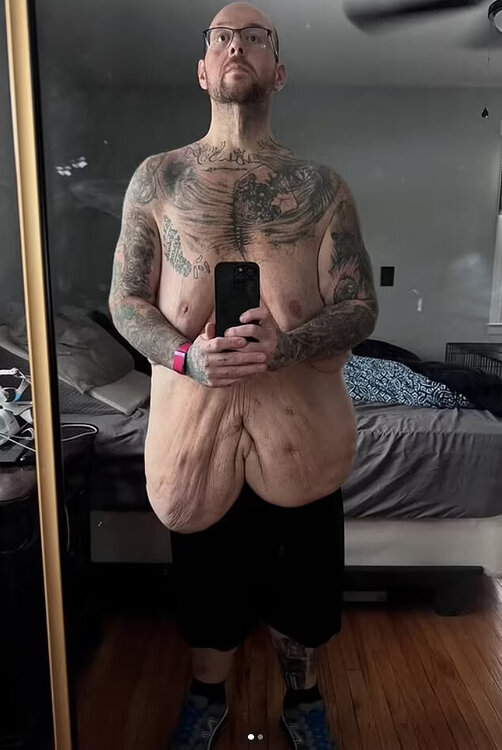
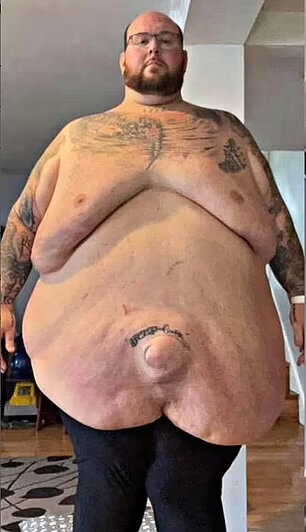
But despite the enormous success he has had, Brennan confessed he isn't feeling nearly as confident as he should — and its all down to the massive amount of loose skin hanging off his body.
When someone puts on a large amount of weight, the skin stretches to accommodate the new size. It may then struggle to return to its original size if someone later loses the weight.
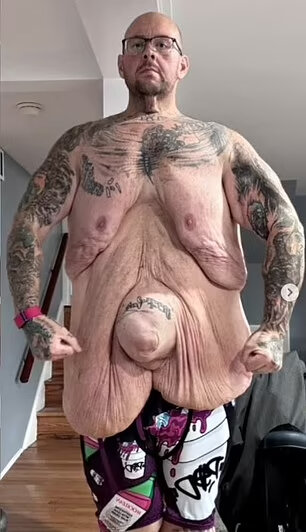
In Brennan's case, his loose skin is 'everywhere' — hanging off his chest, stomach, back, legs, arms, neck and his face. It isn't clear how much it weighs.
Peter is pictured above at the start of his weight loss journey. He has been posting his workouts online
'I don't feel as confident as I should be after doing what I've done,' he said, 'just because I know it is just hanging there'.
'It's not how a normal person should look, I look like I've melted.
'Like, if it wasn't there I would be wearing smaller size clothes, and my legs wouldn't be as hidden.'
As well as getting in the way, the skin can also chafe against itself and clothing — causing him to develop painful rashes that take days to clear up.
His health insurance covered the Wegovy and gastric sleeve surgery, but has declined to cover the skin removal, saying this is cosmetic.
With the mammoth procedure needed, doctors have estimated it will cost $90,000 — which he is fundraising for online. He says he is also considering taking out a loan to cover the rest.
He also had surgery to remove a hernia at his belly button, with a hernia being when part of the intestine, fat or fluid pushes through a weak spot in the abdominal wall and creates a visible bulge.
Hernias may happen because of increased pressure in the abdomen, which may be caused by straining during bowel movements or obesity.
He had had the hernia for ten to 15 years, but it had not previously been possible to treat it owing to his weight.
Pete Brennan, 39, New Jersey, is pictured above at the start of his weight loss journey at 635lbs and today after getting his weight down to 283lbs. The structure in the middle of his stomach is a hernia, which he has now had removed
Brennan is thrilled with his weight loss, but said his confidence has been hit by his loose skin
Amid all the weight loss, Brennan said his life is transformed — with himself now able to help around the house and having a lot more energy.
He also works out six times a week, focusing on a combination of cardio and weight-lifting, and said people no longer stare at him in the street, like they did when he was much larger.
A number of people viewing his photos have said they don't want to lose weight because of the loose skin, but Brennan urged them to reconsider.
He said: 'I would say you just need to put the excuse aside and think more long term about how beneficial it is going to be on your life and how much longer you are going to be able to live.
'And guess what, you can get rid of loose skin with surgery...'
He added: 'Once you're past making excuses and are actually doing it, you will start to love it and start to love the new self you are turning into.'
ARTICLE SOURCE: https://www.dailymail.co.uk/health/article-14511377/ozempic-failure-diet-carnivore-weight-loss.html?
Subscribe to Carnivore Talk on YouTube | Be our guest on the channel | Leave me a voicemail, yo!