Where have all the vegans gone? Over a decade after the first Veganuary, Americans are eating more meat. Has the plant-based movement become a casualty of the pushback against ‘wokeness’? Laura Pitcher Growing up in a vegetarian household, I was aware that being plant-based was deeply uncool for most of my younger years. Then came Veganuary in 2014. In the years that followed, everyone from (albeit dangerous) wellness influencers like Freelee The BananaGirl to celebrities like Arnold Schwarzenegger and Beyoncé were talking about veganism. By 2019, a year The Economist declared “The Year of the Vegan”, meat alternatives were trending: Beyond Meat went public and Impossible Foods scored deals with places like Burger King. Almost all of my friends were switching to oat or almond milk, and even asking for advice on vegan recipes. In that moment, amid a rising interest in the environmental impact of meat consumption and with new technology on the horizon, it felt like plant-based options were the future. Until they weren’t – instead, in recent years, vegan restaurants have been shutting down and sales of beef, pork, lamb, poultry and other meats have hit record highs. On average, Americans ate nearly 7 per cent more meat in 2024 than before the pandemic, and, despite claims that veganism is still growing, only one per cent of Americans said they are vegan in 2023, down from 3 per cent in 2018. Living in New York, it’s a shift I’ve felt throughout the past couple of years, but it’s not just happening in America: In 2023, the number of people identifying as vegan had dropped by 29 per cent in Europe and 15 per cent in the UK. As someone who went vegan in a time when very few alternatives existed, I perhaps got too comfortable with the new array of plant-based products hitting the shelves. As fast as they came, some are already disappearing from my local supermarkets and restaurants, as other vegans on Reddit and Facebook check in with each other across the country: “Are vegan meat substitutes disappearing off the shelf where you live?”. “At its peak, there were substitutes for almost everything: tiramisu, chicken nuggets, smoked salmon alternatives, cheeses, all of it,” says Julia Karolak, a 25-year-old in Switzerland. “But luxury items were the first to go, vegan chocolate is getting harder to find and baked goods, desserts and specialty items that were common a couple of years ago are suddenly gone.” Edinburgh-based lifestyle creator Sophia Slater, otherwise known as “Vegan Soph”, has been vegan since 2019. “Before that, I was a vegetarian for about six months, but the goal was always to be vegan; I just needed to ease my way into it,” she says. The introduction of vegan products, like Gregg’s iconic vegan sausage roll, the same year, helped. “That absolutely shook up the vegan scene and made vegan options on the high street a lot more accessible,” she says. Recently, Slater says there’s been outrage in the vegan community over the removal of Marks & Spencer’s dedicated Plant Kitchen section, and Wagamama cutting Vegatsu and more from their vegan menu. “Even just going to the supermarket now, it’s like, ‘Oh that’s gone’,” says Slater. “It’s been happening slowly but surely, which is sad to see.” Veganism or vegetarianism has existed in multiple cultures and countries throughout history, and I have no doubt it will continue to do so. The current revolt, it seems, is against the puritanical PETA-pilled, white, wellness-infused type of veganism. The culture of putting animals over people, of extremes over empathy, is something I understand is off-putting – I am often not deemed vegan “enough” by extreme vegans because I buy secondhand leather. But today, the stereotype of veganism has gone beyond being annoying to being a symbol of “wokeness”. “The pendulum has swung back toward conservatism, and that shift makes veganism feel like part of a progressive package people currently want distance from,” says Karolak. In the age of Robert F Kennedy Jr’s Make America Healthy Again push towards whole, “unprocessed” animal products, a more animal-based diet has become mainstream, even to many of those who lean left. There’s a growing fear around ultra-processed foods. Also, there’s the fact that, thanks to meat and dairy lobbying, plant-based meat and milks are far more expensive than their animal-based counterparts, making veganism inaccessible for many. But it’s also not exactly a stretch to link the current conservative shift to the declining interest in a plant-based diet: studies have shown that conservatism predicts lapses from vegetarian and vegan diets to meat consumption. Even Peter McGuinness, the current CEO of Impossible Foods, has said that the plant-based sector became too “woke” and “political” for mass appeal. When discussing the link between conservatism and attitudes towards veganism, we have to talk about gender. More specifically, the stereotype that “real men eat meat”, while plant-based men are weak “soy boys”. Elina Vrijsen, a PhD Candidate researching the cultural construction of masculinity in relation to meat consumption at the University of Antwerp, says that the idea that meat is a necessary part of the daily meal (instead of a luxury) has only existed for broad parts of the population since the 20th century. “The link between meat and masculinities was possibly reinforced during the World Wars when there was a rationing system for food, and meat was prioritised for soldiers and working men, under the assumption that they ‘needed’ it for strength and endurance,” she says. “Women, children, and civilians often received less meat.” Flash forward to today, and the post-war cultural narrative that meat is essential for masculinity lives on in manosphere creators who are serving up steak and raw butter on wooden chopping boards online. Vrijsen says the rise of modern fitness culture has often presented meat as an essential part of building a muscular body. “The idea that veganism is ‘feminine’ stems from the fact that food – just like many other elements of social life – is deeply gendered,” says Vrijsen. “Part of this stereotype comes from longstanding assumptions about appetite and bodily needs.” None of this is a surprise if you’re a woman who has had the experience of telling men you are vegan – from countless lectures about protein to threats of hiding meat in dishes, some men make a routine out of having opinions on what women choose to do and consume. There’s also framing of veganism as being gentle or nurturing, traditionally feminine traits, and positioned in contrast to more traditional societal norms. During a time when right-wing nationalist parties across the world are talking about a return to tradition, this push has included more meat on plates. Although the link has not been studied yet, Vrijsen says traditional notions of gender often go hand-in-hand with more conservative political beliefs, and research suggests that men who identify more strongly with traditional ideas of masculinity also tend to consume more meat. “In Belgium, conservative politician Guy D’haeseleer has used meat symbolically in his messaging, positioning the abolition of halal meat and the return of ‘traditional Flemish food’ as campaign points,” Vrijsen says. “In that framework, eating meat becomes a symbol of stability, heritage and resistance to social change – a cultural and political boundary marker.” Meat consumption becoming a symbol of resistance to “wokeness”, of course, does not mean that if you simply eat meat, you are conservative, or that all vegans are progressive. “It’s less about the food itself and more about the political symbolism that different groups project onto it,” says Vrijsen. “The term ‘plant-based’ functions as a rhetorical tool – used strategically to polarize debates around identity, gender and social change.” It’s a battle that takes place in restaurants and supermarkets, often without our awareness. Under capitalist systems, buying plant-based or animal-based products – whichever is trending – is sold not just as a product, but as an identity to consume. For now, and once again, vegans are out of vogue. To some, it’s a relief to no longer be in the spotlight. “In a strange way, daily life has actually become easier now that people mostly dismiss it rather than challenge it,” says Karolak. “Visibility increased, but respect didn’t necessarily follow, so when veganism was at a peak, people seemed almost personally offended by it.” There’s also the fact that a slowdown in hype over vegan food does not necessarily indicate a decline in interest for good. “It may simply mean that plant-based eating is becoming more familiar and integrated into everyday food culture,” says Vrijsen. There are still new plant-based products being released, after all. Other once hopeful vegans like myself are still reminiscing on the moment when it felt like a more plant-based future was possible. “From 2014 to 2019 was a very encouraging and exciting time that made us feel like we were finally making some progress,” says Nzinga Young, a vegan influencer in Cleveland, who went vegan as part of her Vipassana meditation practice. “I was getting attention for being vegan and a Black woman, so I was ‘super woke’ and pandemic brand deals followed.” Now, Young says there’s been a shift in opportunities for vegan creators. She’s worked with brands to promote vegan options, only to have them remove them shortly after. “In January, after the recent election, I knew veganism would become less popular and things would significantly change,” says Young. And they already have, at least until a new wave of mainstream vegan interest – hopefully accompanied by a more welcoming rebrand of what it means to eat more plant-based. ARTICLE SOURCE: https://www.dazeddigital.com/life-culture/article/69135/1/where-have-all-the-vegans-gone-wokeness-plant-based-diet
Like most, prior to carnivore I ate a dumpster diet. And within that dumpster diet I could eat five-gallon buckets at the time. And then do it again and again.
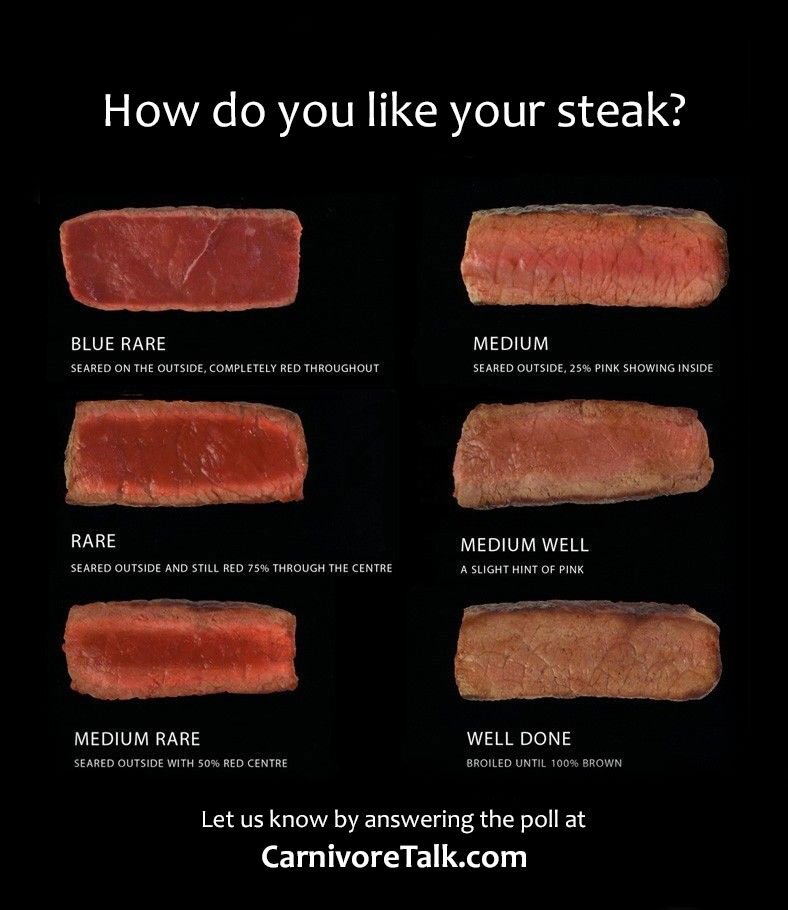
After starting carnivore and gradually ending up on one meal per day (OMAD) I have found I can't eat at that volume anymore. I'm totally impressed with the amounts I hear others can eat. In the past I could eat a big steak, half my wife's steak with a loaded potato, several glasses of sweet tea and then dessert. Follow that with a snack before I went to bed. Now it is just about all I can do to eat the large steak. And with that one steak I am good for at least 24 hours. No hunger whatsoever.
Recently in an attempt to hit a protein target I started with protein powder and then an occasional pre-mixed protein drink. The pre-mixed drink got 50 grams within the day, but it had 11 grams of sugar and carbs (but I forget how many). Soon after putting two and two together I found within an hour of drinking the protein/sugar infused drink I was actually hungry. I tried to offset it with drinking water to proof it was hunger and indeed, it was hunger. So, I ate. I repeated it a few days/week later and it was the same. In the past three to four weeks the only thing that has changed is the addition of 11 grams of sugar maybe twice per week. My appetite has increased drastically to the point I have gained 12 pounds this month.
The intent was to get improvements in the gym and the last month or so I have seen a lot of progress, both in the mirror and counting plates.
Since carnivore is more of an elimination diet than it is a fats/protein diet I am starting to wonder about the 'meat is satiating' references.
Before carnivore I could eat twice as much meat with all the other stuff and since eliminating sugar one big steak is my limit. As I have re-introduced some sugar/carbs my appetite has drastically increased.
Which one is carrying the biggest stick? Is it the satiating meat or the triggers from sugars/carbs. My "individual/just me" experiment indicates sugar/carbs are more powerful to in the body, and maybe the mind than fats and proteins.
Scott