Welcome to our Carnivore / Ketovore / Keto Online Community!
Welcome to Carnivore Talk! An online community of people who have discovered the benefits of an carnviore-centric ketogenic diet with the goal of losing weight, optimizing their health, and supporting and encouraging one another. We warmly welcome you! [Read More]
Just a Carnivore Questions
- Replies 43
- Views 11.1k
- Created
- Last Reply




Most Popular Posts
-
Appreciate it!
-
Yeah, I mentioned this earlier. The milk has carbs, and for some reason dairy products (besides butter & ghee) can cause some people to stall. How tall are you? My experience is si
-
My issue is finding pants to fit over my thighs, I have tree stumps for legs. I'm 6'4", could be my khaki's. I don't wear jeans specifically but khaki's(relaxed fit) that I get from Walmart, th
Posted Images

Featured Replies
Featured Content
-
"World Carnivore Month" January Challenge!
Today is the first day of January and is also the first day of World Carnivore Month. To that end, let's challenge ourselves to eat a carnivore diet for the entire month of January. The type of carnivore diet and the level of strictness you choose to do is entirely up to you. Examples of carnivore diets include the following... 1) The Lion Diet. A person eating the Lion Diet only consumes the flesh of ruminant animals, water, and salt. 2) The BBBE Diet. BBBE is an acronym for Beef, Butter, Bacon, and Eggs. 3) The Carnivore Diet. This allows for the consumption of any and all animals and animal by-products, including dairy. In any of the above examples, the object of course is to not consume any plants as part of your diet. Of course, we're not going to micromanage hoe you prepare your food, so your use of seasonings is entirely your own personal choice. IF your circumstances don't allow you to go full on carnivore in January, then you can participate in this topic by challenge yourself to do better, above and beyond what you have been doing. For example, if you have still been eating grains, seed oils, refined sugar, or drinking alcohol, challenge yourself to avoid these items and just eat a clean, single ingredient whole foods diet such as clean keto, ketovore, or animal based. We encourage you to check in daily, and share what you have eaten, perhaps a weigh-in if you're willing, and enjoy in some small talk. Participants in this topic will be entered into a drawing for a prize at the end of the month.-
- 193 replies
 Featured by Guest
 -
-
What is your favorite way to eat/prepare eggs?
Vote for your favorite way to prepare eggs!
- 45 replies
Featured by Bob



Evening all carnivores,
I just had a question of sorts and maybe advise or guidance.
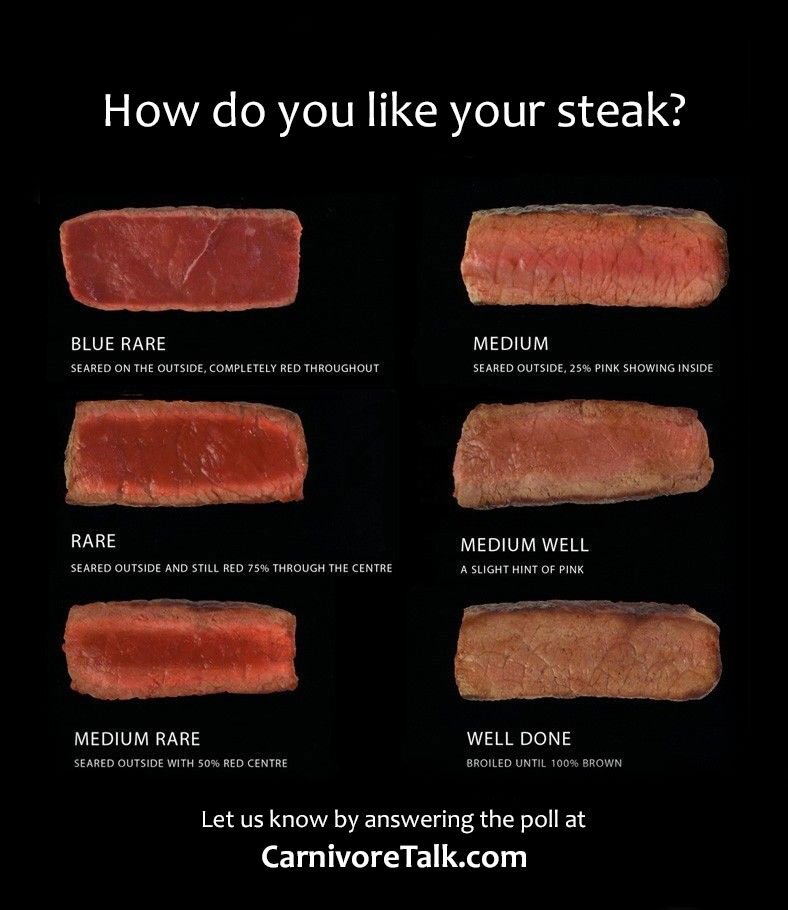
Does anyone else (perhaps other then me) not enjoy steak all that much? I tried ribeye, T-Bone, and even beef stew pieces. I just can't find myself to enjoy the texture as it's always tough to chew. I'm 37(male) with good teeth, no issues eating anything else. I'll describe my daily routine.
On a daily basis (except Saturday/Sunday), I've been eating 1lb beef (from a farmer(s)) with 7 eggs (I get eggs direct from the chicken), milk (specifically Amish Country & 2 cups/day) and I also add either 2 burgers (beef patties) or 2 salmon patties (wild caught, both from Costco) along with cooking with butter (2tbs) to add the extra fat and I use sea salt.
Average is about 150-200g in protein, I don't know the specific on fat with all that unfortunately nor calories. Protein was easy to pretty easy to gather and I go to gym 6 days a week (5 good days, the 6th day is mostly what couldn't be finished before the gym closed and extra cardio).
Saturdays I don't have any of the above and try to use that day as a variety meat day such as adding ribs though it's restaurant purchased and sadly not bare so it has some sort of sauce/rub on it and smoked. I may also try to add some sort of steak even if small.
Sundays though I add bison or venison in substitute to beef for the meal plan above but the rest is normally the same.
Also, I do fasting, my window is normally 1p-7pm but I don't cook anything more except finish/snack on what I don't eat above to finish it all throughout the day and have milk before going to the gym.
Am I safe with just eating above as is, should I add anymore to up my intake of fat somewhere? Or am I pretty good as is? If someone is able to calculate the correct amounts.
I do have LMNT (unflavored) and only take it if I feel sluggish/tired.
Appreciate the reading of a long message!
Drew